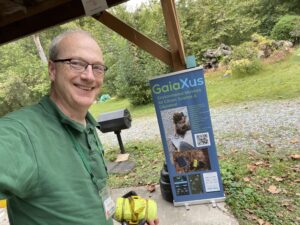
This past Saturday, our local chapter of the Izaak Walton League hosted its annual Hunting and Fishing Day, and once again the lakeside pavilion filled with people who care about the outdoors, whether through their work, their hobbies, or their curiosity.
We brought our Water Guardians to show how students, citizen scientists, and anyone interested can explore what’s really happening in their water. One sensor sat in the lake, another at our table where we moved it between clear water and buckets with sediment or salt. It wasn’t a technical demo so much as an invitation: here’s how you can see the difference, here’s how data becomes personal.
The amazing team from the Montgomery County Department of Natural Resources showed off a huge Dobson fly larva—an insect that only survives in clean streams. The kids who crowded around were fascinated; they didn’t need a lecture to understand what it meant: if the water isn’t clean, the creature disappears. That direct connection between what lives in the creek and the quality of the water was the kind of moment you don’t forget.
The atmosphere at the pavilion was relaxed but purposeful. Agencies had live stream critters in trays, the Girl Scouts demonstrated how salt moves through a watershed, Trout Unlimited volunteers tied fishing flies, and hunters spoke about habitat. Different backgrounds, different perspectives—but everyone connected by the same truth: healthy streams and forests are the foundation for everything else.
That balance to use and enjoyment on one hand, conservation on the other, is as relevant now as it was when the League began a century ago. Hunting, fishing, hiking, teaching science, all of it depends on clean water and intact habitats.
At GaiaXus, we see our role as extending that balance into American classrooms and communities. Our sensors and software are designed not just to measure water quality, but to make the process accessible, meaningful, and adaptable to different users, whether a student exploring their first science lesson, a teacher aligning with standards, or a community group tracking local conditions. By lowering the cost and complexity of monitoring, we make it possible for more people to see, understand, and act on the state of their water. In doing so, we hope to help turn conservation from an abstract principle into a daily practice, one that sustains both the environment and the people who depend on it.