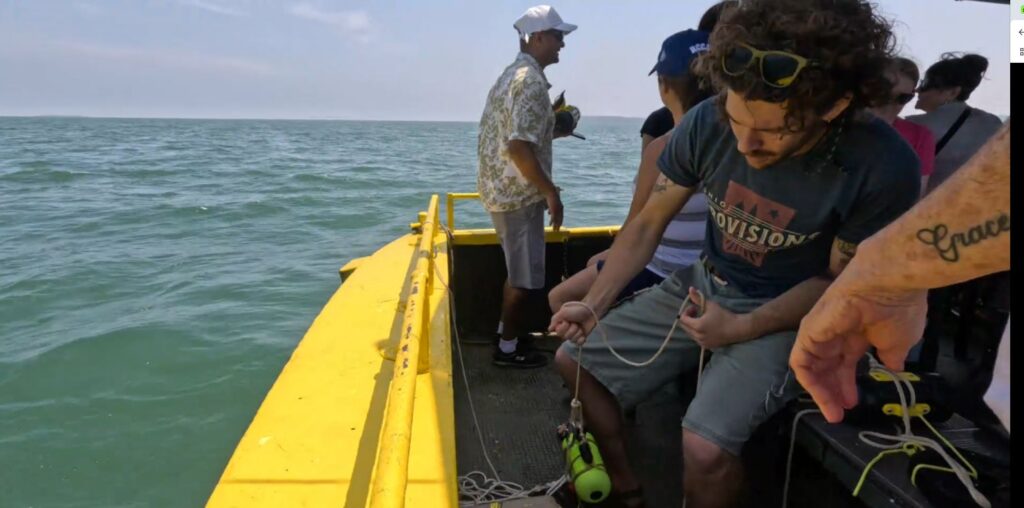
Last week, I had the opportunity to spend two inspiring days with a group of dedicated Ohio educators on Lake Erie, engaging directly with water quality monitoring and STEM teaching tools in the field.
This professional development event was organized by two of our long-time collaborators: Jim Bader, Executive Director of the Leonard Gelfand STEM Center at Case Western Reserve University, and Shari Insley, a middle school science teacher and recipient of the 2024 Presidential Innovation Award for Environmental Educators. Jim and Shari have played a vital role in shaping our work since the early days of GaiaXus, helping us refine our tools and build meaningful educator partnerships.
We started the trip at Kelley’s Island ferry terminal, crossing into Lake Erie for a hands-on science experience. Jim led an on-site discussion about lake stratification and seasonal water dynamics. In this region, where the lake is relatively shallow (approximately 30 feet or 10 meters), vertical stratification is less pronounced than in the deeper eastern basin. Still, the area faces serious environmental stressors. Harmful algal blooms (HABs), driven by excess nutrient loading, lead to large hypoxic zones and degraded water clarity. These disruptions have direct economic consequences for Lake Erie’s $1.5 billion recreational fishing industry (*) —especially for species like walleye and yellow perch.
These real-world issues provide a powerful teaching opportunity. Participating educators used this context to explore the science behind water quality, test sensors, and discuss how they can engage students with local environmental challenges.
Aboard a chartered research vessel, we deployed a variety of tools, including an EPA-loaned Hydrolab Sonde, plankton nets, and four GaiaXus Water Guardians. Each Water Guardian was used in a different mode—from vertical profiling to surface towing. The towing configuration, originally designed for kayaks and canoes, also performed well behind a low-speed vessel. As always, the integrated GPS in our mobile app logged location and data automatically, creating a clear and useful spatial profile of lake conditions.
This event offered a chance to demonstrate what we aim to deliver: a platform that is affordable, versatile, and easy to use. Whether mounted to a dock, dropped vertically, or towed through surface waters, the Water Guardian adapts to the needs of educators and citizen scientists—without requiring complex setup or specialized training.
We’re deeply grateful to the Ohio STEM community for their commitment to science education and for sharing this meaningful field experience with us. If you're an educator, program coordinator, or scientist looking to enhance your water science programming, we’d love to connect.
Contact us to explore how GaiaXus can support your STEM education or environmental science initiatives.
(*) Wolf, D., Georgic, W., & Klaiber, H. A. (2017). Reeling in the damages: Harmful algal blooms' impact on Lake Erie’s recreational fishing industry. Journal of Environmental Management, 199, 148–157. https://doi.org/10.1016/j.jenvman.2017.05.031