
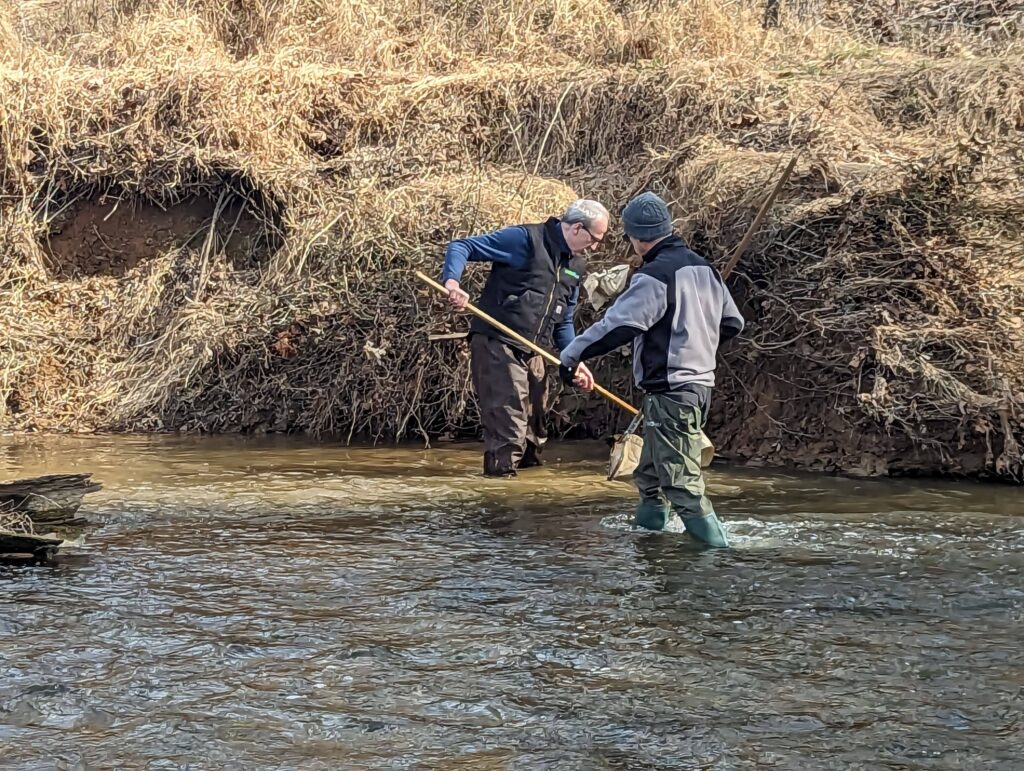
One winter morning, I found myself chest-deep in an icy swamp with ten volunteers cleaning up nesting boxes and tabulating the breeding success of migratory wood ducks. The volunteers were hunters, fiercely protective of their ducks’ habitat even when the birds were relaxing on a beach somewhere south. During that morning, I learned a lot about ducks, their nesting behavior, and the ecosystem in a nearly inaccessible swamp and I learned not to grab beaver scat.
The Good
Citizens are doing science for all sorts of reasons, and a lot more than academic researchers give them credit for. These conservation and research projects are very common and generally run by folks who genuinely know what they are doing and why. They are determined, motivated, and rarely paid. Watershed groups, students, anglers, hikers, retirees, all logging water clarity, temperature, and algae blooms. NOAA alone counts over half a million volunteers contributing a million field hours a year. The success of iNaturalist, GLOBE, eBird, and so many other programs is unquestionable. Citizen science isn’t a sideshow, it’s the backbone of environmental monitoring.
Across disciplines, its scale is now measurable and substantial. The global citizen-science movement has engaged an estimated 14 million participants over the past two decades, producing datasets that span terrestrial, marine, and atmospheric systems (PLOS ONE, 2023). According to a 2024 analysis of the SciStarter registry, there are currently 2,346 active projects focused specifically on ecology and environmental sciences. Participation is no longer marginal; a Pew Research Center study found that 10 percent of U.S. adults have engaged in a citizen-science activity in the past year, and 26 percent have done so at least once.
Long-standing initiatives demonstrate both durability and scientific credibility. The National Audubon Society’s Christmas Bird Count, operating since 1900, mobilizes over 80,000 volunteers annually who record observations of more than 40 million birds across the Western Hemisphere. In coastal and marine environments, the Ocean Conservancy’s International Coastal Cleanup enlisted nearly 500,000 volunteers in 2023, who collected over 14 million pieces of trash from shorelines worldwide.
These numbers illustrate that citizen-collected data are not anecdotal or decorative. They represent the largest single source of ecological observations on the planet, and their influence is expanding from outreach into empirical research.
By the way, everyone has their own definition of “citizen science,” and some government agencies now call it “community science.” But they all mean the same thing: when laypeople come together and “do science,” largely unpaid but to usable scientific standards, it qualifies in my book.
The Bad
Academic researchers frequently look down on citizen science and see it mainly as a way to generate visibility and engagement to support their next grant application. “Real science,” they say, can only be done by paid professionals. And maybe they’re right, but unfortunately, environmental science isn’t exactly flush with research money at the moment. So, science either doesn’t get done at all, or we collectively need to rethink science less as an esoteric art practiced by professors talking down to the unwashed masses, and more as a collaborative endeavor where scientists bring their experience and education into leadership roles to guide, support, and strengthen volunteer-driven projects. And in the process, learn that the folks who do the actual work are equals, peers, not subjects.
For that to work, we need to address the concerns that researchers have with citizen science. I interviewed a number of people from universities, government, schools, and volunteer groups, and the three most mentioned obstacles are:
- Data quality. The concern is that data generated by unsupervised volunteers just isn’t accurate, reproducible, or meaningful.
- Data consistency. Environmental researchers require multi-year, consistently acquired data to allow analysis, hypothesis development, and predictions. Volunteers are sometimes harder to chase into a snowstorm than starving graduate students.
- Cultural/structural distrust and “professionalization” bias. Individual researchers may be supportive of citizen science and satisfied with the data, but they face a much harder time publishing it when it was generated by volunteers. At a time when each publication is hard-won, rejection of a major paper can derail a young scientist’s career, and playing it safe is, unfortunately, wise. Department heads, supervisors, and academic leaders who write large institutional grants know this all too well and cannot allow the reputation of their teams to suffer.
The Future
So, how do we go forward? Given the funding situation and the need to increase (not reduce) environmental research, waiting for better budget times isn’t going to cut it. Even with full budgets, we will never be able to scale professional academic research to the level needed to combat the multitude of environmental problems humanity faces. The only realistic way is to rethink how citizen science can gain genuine support and appreciation from researchers while, at the same time, not losing the casual nature of volunteering.
In the next article, we’ll discuss a few approaches and examples how we can do this. I promise the article will be online before the ducks come back from their summer camp.